Tamiya Subaru Impreza WTC - 24199
In 1990, Subaru introduced the 4WD sedan Legacy as a participant in the 3rd Safari Rally of the World Rally Championship (WRC). However, starting from 1993, Subaru decided to replace the Legacy with their new compact model, the Impreza, for the 1000 Lakes Rally. The Impreza underwent multiple modifications to meet the requirements of being a World Rally Car, as it had more flexibility in terms of modification regulations compared to Group A.
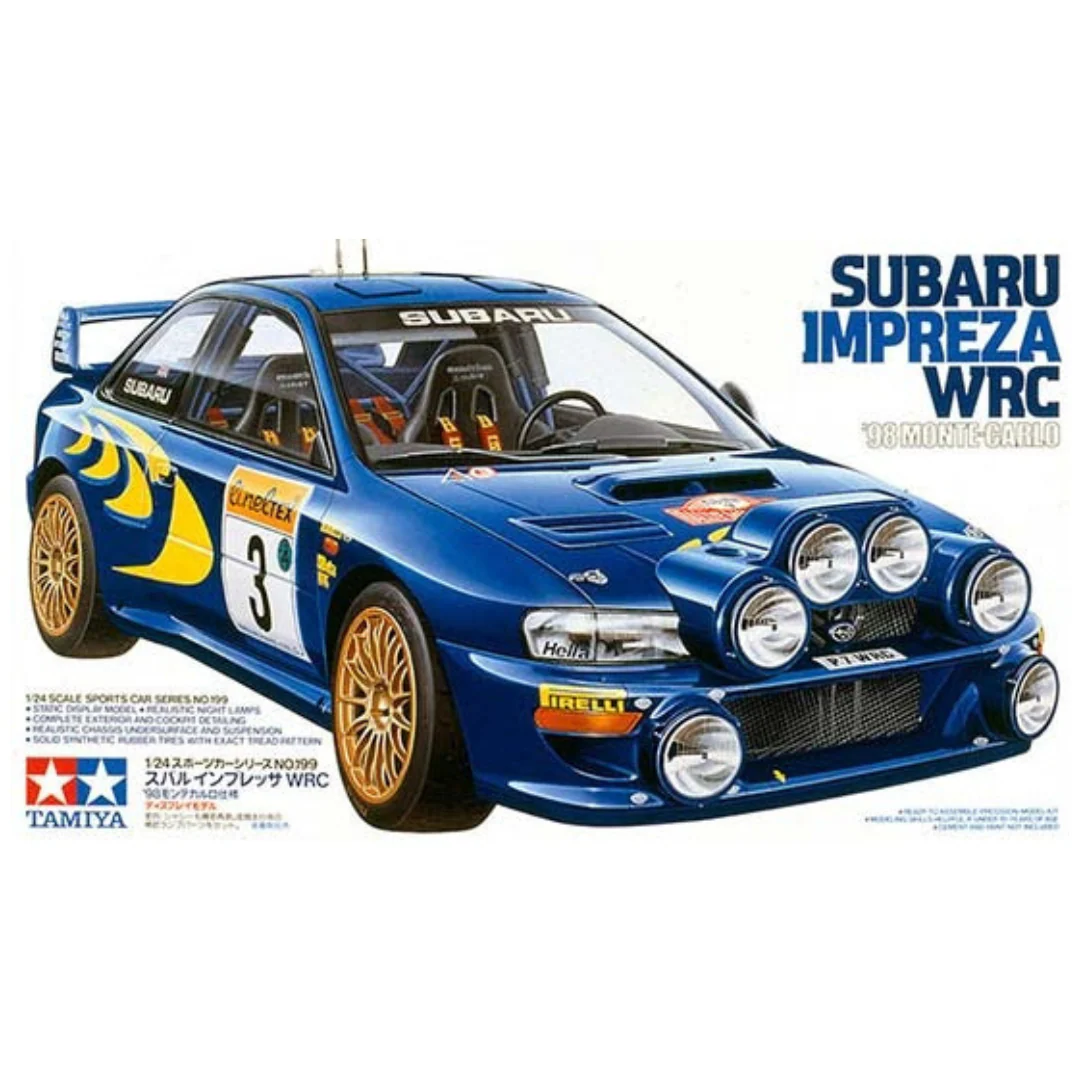
Subaru quickly established itself as one of the top contenders in the WRC. The Impreza featured extended blister fenders by 177mm, a front spoiler for radiator cooling, and a rear wing for generating downforce. These spoilers were meticulously designed based on wind tunnel testing. The horizontally placed 4-cylinder turbocharged engine delivered an impressive power output of over 300 horsepower. To optimize weight distribution, the engine was moved as far back as possible, and the intercooler with an air-cooling system was positioned at the front. Additionally, the front and center sections were equipped with electronically controlled active differentials operated hydraulically. In 1998, the engine underwent further modifications, including changes to the crankshaft and intake manifold. The front grille was widened to allow for better airflow, and the body structure was strengthened with the addition of a roll bar on the B-pillar.
The Subaru team consisted of drivers such as Colin McRae, who was the primary driver, Piero Liatti, and Kenneth Eriksson. McRae secured victories in the 4th race in Portugal and the 6th race in Tour-de-Corse. The Impreza demonstrated its tremendous potential on the stages of the WRC.
Paints and glue not included.
Product Information
Product Information
Shipping & Returns
Shipping & Returns
Tamiya Subaru Impreza WTC - 24199
Tamiya Subaru Impreza WTC - 24199
In 1990, Subaru introduced the 4WD sedan Legacy as a participant in the 3rd Safari Rally of the World Rally Championship (WRC). However, starting from 1993, Subaru decided to replace the Legacy with their new compact model, the Impreza, for the 1000 Lakes Rally. The Impreza underwent multiple modifications to meet the requirements of being a World Rally Car, as it had more flexibility in terms of modification regulations compared to Group A.
Subaru quickly established itself as one of the top contenders in the WRC. The Impreza featured extended blister fenders by 177mm, a front spoiler for radiator cooling, and a rear wing for generating downforce. These spoilers were meticulously designed based on wind tunnel testing. The horizontally placed 4-cylinder turbocharged engine delivered an impressive power output of over 300 horsepower. To optimize weight distribution, the engine was moved as far back as possible, and the intercooler with an air-cooling system was positioned at the front. Additionally, the front and center sections were equipped with electronically controlled active differentials operated hydraulically. In 1998, the engine underwent further modifications, including changes to the crankshaft and intake manifold. The front grille was widened to allow for better airflow, and the body structure was strengthened with the addition of a roll bar on the B-pillar.
The Subaru team consisted of drivers such as Colin McRae, who was the primary driver, Piero Liatti, and Kenneth Eriksson. McRae secured victories in the 4th race in Portugal and the 6th race in Tour-de-Corse. The Impreza demonstrated its tremendous potential on the stages of the WRC.
Paints and glue not included.
Original: $25.41
-70%$25.41
$7.62Product Information
Product Information
Shipping & Returns
Shipping & Returns
Description
In 1990, Subaru introduced the 4WD sedan Legacy as a participant in the 3rd Safari Rally of the World Rally Championship (WRC). However, starting from 1993, Subaru decided to replace the Legacy with their new compact model, the Impreza, for the 1000 Lakes Rally. The Impreza underwent multiple modifications to meet the requirements of being a World Rally Car, as it had more flexibility in terms of modification regulations compared to Group A.
Subaru quickly established itself as one of the top contenders in the WRC. The Impreza featured extended blister fenders by 177mm, a front spoiler for radiator cooling, and a rear wing for generating downforce. These spoilers were meticulously designed based on wind tunnel testing. The horizontally placed 4-cylinder turbocharged engine delivered an impressive power output of over 300 horsepower. To optimize weight distribution, the engine was moved as far back as possible, and the intercooler with an air-cooling system was positioned at the front. Additionally, the front and center sections were equipped with electronically controlled active differentials operated hydraulically. In 1998, the engine underwent further modifications, including changes to the crankshaft and intake manifold. The front grille was widened to allow for better airflow, and the body structure was strengthened with the addition of a roll bar on the B-pillar.
The Subaru team consisted of drivers such as Colin McRae, who was the primary driver, Piero Liatti, and Kenneth Eriksson. McRae secured victories in the 4th race in Portugal and the 6th race in Tour-de-Corse. The Impreza demonstrated its tremendous potential on the stages of the WRC.
Paints and glue not included.