✨ New Arrivals Just Dropped!Explore

Catan (5th Edition) Board Game
In CATAN, formerly known as The Settlers of Catan, players aim to establish their dominance on the island of Catan through the construction of settlements, cities, and roads. The game operates on the roll of dice, which dictate the island's resource production during each turn. To build structures, players expend resources like sheep, wheat, wood, brick, and ore, represented by resource cards. Each type of land, except for the barren desert, yields a specific resource: hills produce brick, forests provide wood, mountains yield ore, fields generate wheat, and pastures produce sheep.
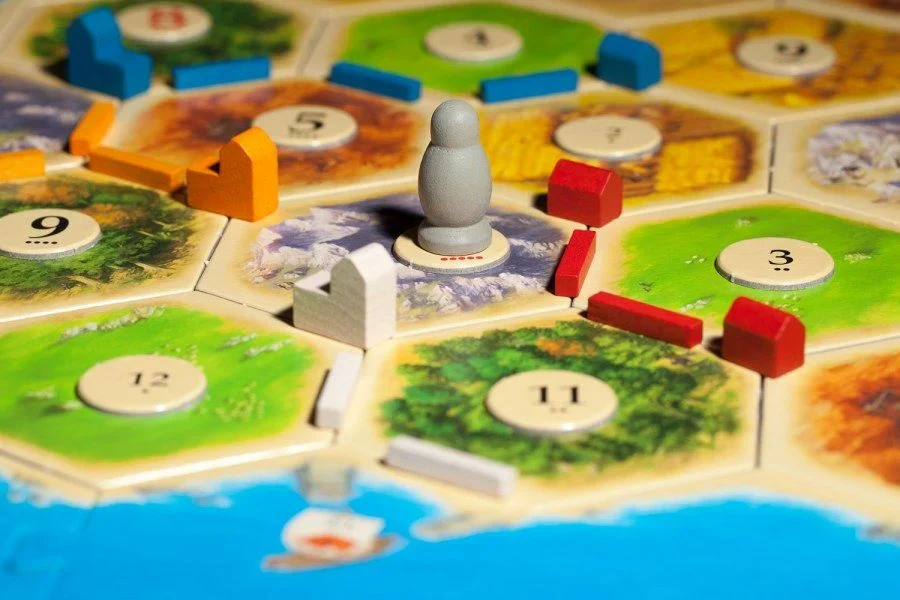
The setup involves the random placement of large hexagonal tiles, each displaying a resource or the desert, in a honeycomb pattern, surrounded by water tiles, some of which contain exchange ports. Number disks, corresponding to die rolls (using two 6-sided dice), are placed on each resource tile. Each player receives two settlements (resembling houses) and roads (resembling sticks), which they place at the intersections and borders of the resource tiles. Players collect resource cards based on the hex tiles adjacent to their last-placed houses. A robber pawn is positioned on the desert tile.
A turn encompasses potential actions such as playing a development card, rolling the dice, acquiring resource cards based on roll results and house positions (or upgraded cities resembling hotels), exchanging resource cards for improvements, trading cards at a port, and trading resource cards with other players. Rolling a 7 prompts the active player to move the robber to a different hex tile, enabling the theft of resource cards from players with structures adjacent to that tile.
Points are earned by constructing settlements and cities, achieving the longest road and the largest army (via certain development cards), and obtaining specific development cards that grant victory points. When a player amasses 10 points (some of which can be concealed), they declare their total and claim victory.
CATAN has received numerous awards and stands as one of the most popular games in recent history, appealing to both experienced gamers and newcomers to the hobby.
The setup involves the random placement of large hexagonal tiles, each displaying a resource or the desert, in a honeycomb pattern, surrounded by water tiles, some of which contain exchange ports. Number disks, corresponding to die rolls (using two 6-sided dice), are placed on each resource tile. Each player receives two settlements (resembling houses) and roads (resembling sticks), which they place at the intersections and borders of the resource tiles. Players collect resource cards based on the hex tiles adjacent to their last-placed houses. A robber pawn is positioned on the desert tile.
A turn encompasses potential actions such as playing a development card, rolling the dice, acquiring resource cards based on roll results and house positions (or upgraded cities resembling hotels), exchanging resource cards for improvements, trading cards at a port, and trading resource cards with other players. Rolling a 7 prompts the active player to move the robber to a different hex tile, enabling the theft of resource cards from players with structures adjacent to that tile.
Points are earned by constructing settlements and cities, achieving the longest road and the largest army (via certain development cards), and obtaining specific development cards that grant victory points. When a player amasses 10 points (some of which can be concealed), they declare their total and claim victory.
CATAN has received numerous awards and stands as one of the most popular games in recent history, appealing to both experienced gamers and newcomers to the hobby.
Product Information
Product Information
Shipping & Returns
Shipping & Returns


Catan (5th Edition) Board Game
Catan (5th Edition) Board Game
In CATAN, formerly known as The Settlers of Catan, players aim to establish their dominance on the island of Catan through the construction of settlements, cities, and roads. The game operates on the roll of dice, which dictate the island's resource production during each turn. To build structures, players expend resources like sheep, wheat, wood, brick, and ore, represented by resource cards. Each type of land, except for the barren desert, yields a specific resource: hills produce brick, forests provide wood, mountains yield ore, fields generate wheat, and pastures produce sheep.
The setup involves the random placement of large hexagonal tiles, each displaying a resource or the desert, in a honeycomb pattern, surrounded by water tiles, some of which contain exchange ports. Number disks, corresponding to die rolls (using two 6-sided dice), are placed on each resource tile. Each player receives two settlements (resembling houses) and roads (resembling sticks), which they place at the intersections and borders of the resource tiles. Players collect resource cards based on the hex tiles adjacent to their last-placed houses. A robber pawn is positioned on the desert tile.
A turn encompasses potential actions such as playing a development card, rolling the dice, acquiring resource cards based on roll results and house positions (or upgraded cities resembling hotels), exchanging resource cards for improvements, trading cards at a port, and trading resource cards with other players. Rolling a 7 prompts the active player to move the robber to a different hex tile, enabling the theft of resource cards from players with structures adjacent to that tile.
Points are earned by constructing settlements and cities, achieving the longest road and the largest army (via certain development cards), and obtaining specific development cards that grant victory points. When a player amasses 10 points (some of which can be concealed), they declare their total and claim victory.
CATAN has received numerous awards and stands as one of the most popular games in recent history, appealing to both experienced gamers and newcomers to the hobby.
The setup involves the random placement of large hexagonal tiles, each displaying a resource or the desert, in a honeycomb pattern, surrounded by water tiles, some of which contain exchange ports. Number disks, corresponding to die rolls (using two 6-sided dice), are placed on each resource tile. Each player receives two settlements (resembling houses) and roads (resembling sticks), which they place at the intersections and borders of the resource tiles. Players collect resource cards based on the hex tiles adjacent to their last-placed houses. A robber pawn is positioned on the desert tile.
A turn encompasses potential actions such as playing a development card, rolling the dice, acquiring resource cards based on roll results and house positions (or upgraded cities resembling hotels), exchanging resource cards for improvements, trading cards at a port, and trading resource cards with other players. Rolling a 7 prompts the active player to move the robber to a different hex tile, enabling the theft of resource cards from players with structures adjacent to that tile.
Points are earned by constructing settlements and cities, achieving the longest road and the largest army (via certain development cards), and obtaining specific development cards that grant victory points. When a player amasses 10 points (some of which can be concealed), they declare their total and claim victory.
CATAN has received numerous awards and stands as one of the most popular games in recent history, appealing to both experienced gamers and newcomers to the hobby.
$11.65
Original: $38.82
-70%Catan (5th Edition) Board Game—
$38.82
$11.65Product Information
Product Information
Shipping & Returns
Shipping & Returns
Description
In CATAN, formerly known as The Settlers of Catan, players aim to establish their dominance on the island of Catan through the construction of settlements, cities, and roads. The game operates on the roll of dice, which dictate the island's resource production during each turn. To build structures, players expend resources like sheep, wheat, wood, brick, and ore, represented by resource cards. Each type of land, except for the barren desert, yields a specific resource: hills produce brick, forests provide wood, mountains yield ore, fields generate wheat, and pastures produce sheep.
The setup involves the random placement of large hexagonal tiles, each displaying a resource or the desert, in a honeycomb pattern, surrounded by water tiles, some of which contain exchange ports. Number disks, corresponding to die rolls (using two 6-sided dice), are placed on each resource tile. Each player receives two settlements (resembling houses) and roads (resembling sticks), which they place at the intersections and borders of the resource tiles. Players collect resource cards based on the hex tiles adjacent to their last-placed houses. A robber pawn is positioned on the desert tile.
A turn encompasses potential actions such as playing a development card, rolling the dice, acquiring resource cards based on roll results and house positions (or upgraded cities resembling hotels), exchanging resource cards for improvements, trading cards at a port, and trading resource cards with other players. Rolling a 7 prompts the active player to move the robber to a different hex tile, enabling the theft of resource cards from players with structures adjacent to that tile.
Points are earned by constructing settlements and cities, achieving the longest road and the largest army (via certain development cards), and obtaining specific development cards that grant victory points. When a player amasses 10 points (some of which can be concealed), they declare their total and claim victory.
CATAN has received numerous awards and stands as one of the most popular games in recent history, appealing to both experienced gamers and newcomers to the hobby.
The setup involves the random placement of large hexagonal tiles, each displaying a resource or the desert, in a honeycomb pattern, surrounded by water tiles, some of which contain exchange ports. Number disks, corresponding to die rolls (using two 6-sided dice), are placed on each resource tile. Each player receives two settlements (resembling houses) and roads (resembling sticks), which they place at the intersections and borders of the resource tiles. Players collect resource cards based on the hex tiles adjacent to their last-placed houses. A robber pawn is positioned on the desert tile.
A turn encompasses potential actions such as playing a development card, rolling the dice, acquiring resource cards based on roll results and house positions (or upgraded cities resembling hotels), exchanging resource cards for improvements, trading cards at a port, and trading resource cards with other players. Rolling a 7 prompts the active player to move the robber to a different hex tile, enabling the theft of resource cards from players with structures adjacent to that tile.
Points are earned by constructing settlements and cities, achieving the longest road and the largest army (via certain development cards), and obtaining specific development cards that grant victory points. When a player amasses 10 points (some of which can be concealed), they declare their total and claim victory.
CATAN has received numerous awards and stands as one of the most popular games in recent history, appealing to both experienced gamers and newcomers to the hobby.